
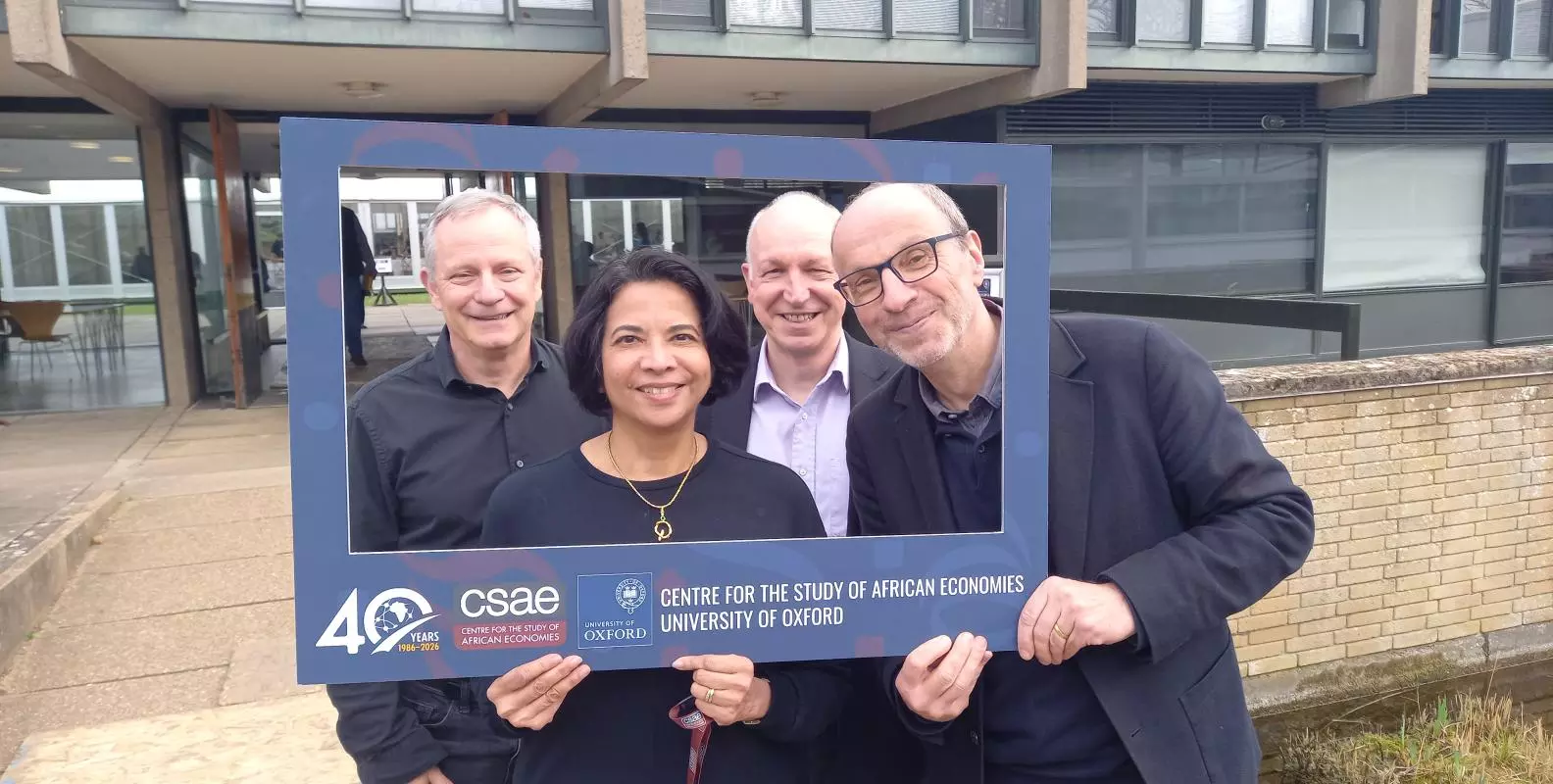
We spoke with Christopher Adam and Pramila Krishnan, who joined CSAE in 1992 as Research Officers (now known as Postdoctoral Researchers). Both are currently Professors of Economic Development at the Oxford Department of International Development and remain actively involved with the Centre. In this conversation, they share their reflections on how CSAE has changed over the years and the experiences that shaped its early development.
What first drew you to join the Centre in its earliest days?
PK: It was the idea of beginning a new research programme. Paul Collier wished to start up the collection of panel data on households and later firms in sub-Saharan Africa. The idea was that good quality micro-level data, comparable across countries was scarce and was part of the reason why research on sub-Saharan Africa was thin. Most research was on macroeconomic themes using agregate data. An early workshop was organised, drawing in the grandees of applied development economics such as Tim Besley, Angus Deaton, Paul Glewwe (began the important LSMS surveys in 1985) and Chris Udry. And the theme of that workshop was to discuss the new and open research questions to exploit the panel data surveys that would be designed for purpose. I had written my Phd thesis on Self selection models and random parameters, which felt rather obscure and abstract – but working on a panel survey actually offered a chance for the topic to redeem itself and even be useful. And perhaps, at least for me, the opportunity to work on Africa, a continent I had never visited – or indeed studied at all. The sheer excitement of that will stay with me forever.
What motivated you to apply for the CSAE Visiting Fellowship when it was first announced?
Founded in 1986, CSAE has consistently been at the forefront of microeconomic and macroeconomic research across Africa. The Centre oversees the Journal of African Economies, a publication known for its detailed analysis and regarded as one of the most authoritative sources on African development. Having participated in the CSAE annual conference and being a development economist with a focus on Africa, I naturally wanted to foster my research by participating in the visiting fellowship of the Centre. The African Economic Research Consortium facilitated my participation.
CA: I was coming to the end of my DPhil at Oxford and considering taking a junior economists offer at the IMF. But I was persuaded (by Paul and David Bevan) that a spell at CSAE -- during its inception period -- would be much more fun and rewarding...
Did you feel you were building
something new or experimental
at the time?
CA: Absolutely! There wasn’t, as far as I could see, anything else like CSAE at the time. It was aiming to (successfully) bring frontier quantitative economics research to bear on theoretical and applied micro and micro economics problems in Africa.
This was new and innovative (hitherto the economic research community working on Africa was dominated by more heterodox approaches that tended to shun the innovative methodological approaches those in CSAE were using. Its emergence coincided with the early days of the African Economic Research Consortium and the two fledgling institutions worked together quite closely (David Bevan, Paul Collier, Jan Willem Gunning were established Resource Persons at that time; I ran the first econometrics workshops for the AERC and because a Resource Person shortly after, joining the Board, representing DFID, from 2006-16; Anke and Pramila, who was my successor as DFID/FCDO Board director, joined a bit later).
PK: Absolutely, in particular, the idea was to begin with Ethiopia, a country that had just come out of two decades of civil war, a famine – it was a new beginning for the country. The two things coincided, new data and research – in a country faced with enormous challenges and lead by an inspirational leader who really left his mark.
What was the academic or research environment like when the Centre began?
PK: The CSAE was housed in the Institute of Economics and Statistics in the old Manor Road Building. It had a very different feel from that of an established department where people work in parallel across different areas - and very much more that of a laboratory. We had regular seminars as we do now – but also a standard departmental seminar. What stood out for me was the presence of Professor Sir Stephen Nickell (a grandee forever), partly because he was a statistician – but also because one could drop in to his office to ask what were likely minor questions but were treated seriously. He could devastate a talk with a single comment – but more likely, help set one straight when wobbling in an explanation. Paul Collier infused energy and excitement into everything we engaged in – and David Bevan and John Knight (the other co-founders) kept us grounded. All of them cared as much for asking good (and under researched) economics questions while keeping a leery eye on policy without a knee-jerk “what does this mean for policy”.
What were the major research questions or projects you worked on during this early time?
PK: I had carried with me a copy of An Inquiry into Well-Being and Destitution by Professor Sir Partha Dasgupta at Cambridge, a new book on Development Economics. It is a fantastic read even after 35 years. Every chapter in it was an inspiration in charting important theoretical questions that had received little attention. The chapters on household economics and risk and insurance were gripping – and were the inspiration for the first few papers on how households cope with risk – and how spouses might offer each other insurance against health shocks for instance.
CA: My first main research programme with CSAE was an extended EC-funded research programme on Zambia, led by David Bevan.
Were there moments when you realised the Centre was having a broader impact?
PK: We knew it was so. Paul, David and Jan-Willem, the collaborators whose joint work on “Constrained Open Economies”, which in turn led to the founding of the CSAE with ESRC support, had a strong engagement with many African governments. Paul would return from each of his trips (he must certainly have had several frequent flyer cards) with tales of such meetings and their impact. The AERC (the African Economic Research Consortium) had a strong link to the CSAE with Chris Adam, myself and others advising researchers from the continent – and we felt very engaged. This was far more than scholars working with Africa
What do you think has been the Centre’s greatest contribution to its field?
CA: In helping to create a community of scholars – in the UK, Europe, Africa and elsewhere -- committed to high-quality applied research on the fundamental issues of economic development and structural change.
How has the CSAE grown or changed since you joined?
PK: The CSAE has broadened to embrace excellent work beyond Africa and across development economics. There are a large number of excellent DPhil students since development economics has grown rapidly as a field. But even more important, it has evolved as a centre for supporting African researchers, through its Fellowship programme, the Journal of African Economies – and the annual conference, which brings together researchers working on Africa who are increasingly from the continent. Thus research on Africa remains the main focus, as it must.
What values or principles from those early days do you hope continue?
CA: Commitment to quality, to fostering the emerging generation of African and other researchers, engagement with policymakers and others on a ‘trusted partner’ basis.
PK: The focus on sub-Saharan Africa in the research; the sheer excitement of working in and on that most exciting of continents with an avowed interest in the themes that matter for it in the next decades – and perhaps the unselfish interest in research on it that supersedes a narrow interest in treating the continent as a laboratory for furthering a career rather than any real interest in it. It should be emphasised that belonging to the CSAE creates an important network for researchers and policymakers to exploit their joint interests.