

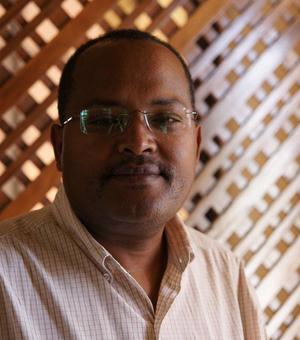
Dambala is an Associate Professor of Economics at the University of the Witwatersrand (Wits), Johannesburg.He holds a PhD in Economics from the University of Pretoria and an MSc in Economics from the Norwegian University of Life Sciences. Dambala is a member of the Econometric Society, the European Association of Environmental and Resource Economists (EAERE), and Economic Society of South Africa(ESSA).
Dambala's research sits at the intersection of behavioral economics, institutional analysis, and development microeconomics, combining theory and empirical evidence to explain how bounded rationality, institutional incentives, and organizational constraints shape economic behavior, development and environmental outcomes in developing and middle-income countries.
Dambala's current and emerging research themes include:
Behavioural economics: I study (i) social learning and technology adoption; (ii) saving for children’s schooling and the design of commitment devices; and (iii) limited attention in choices, including health-plan selection, weather-index insurance and menu of green-energy technologies.
Institutional and organisational questions: I analyse how alternative enforcement institutions sustain cooperation in commons management. I also study the political-economy constraints to a just energy transition—how organised interests, distributional conflict, and credibility problems shape the pace and composition of decarbonisation. Related work examines commitment frictions in clean-energy investment, highlighting how hold-up risk and time-inconsistent policy can deter investment: through renegotiation by private counterparties once relationship-specific assets are sunk, and through governments whose policy commitments lack credibility over time
Development microeconomics: I analyse poverty traps through the dynamics of asset and human-capital accumulation shaped by behavioural frictions and institutional environments.
Methodologically, for the most part, I use quasi-experimental designs (natural experiments and policy discontinuities) and field experiments to test theory and evaluate policy/program interventions. Recently, I have started using causal machine learning methods for impact evaluation of policy/program interventions and shocks including the COVID pandemic.