
CSAE Economic Development in Africa Workshop 2025 Roundup
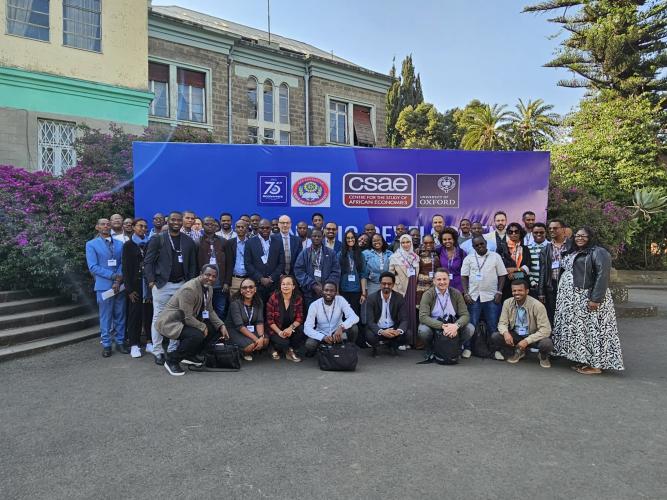
This year's CSAE Economic Development in Africa Workshop in December 2025 brought CSAE's annual conference community to the University of Addis Ababa. The workshop was held at the Institute for Ethiopian Studies, home for research, libraries and the display of Ethiopia's cultural heritage alike in the middle of Ethiopia's oldest university. Like the CSAE main conference in March, for five days researcher from all over Africa, from Oxford University, and the world came together to present and discuss the latest economic research on Africa. Each day covered one or more focus topics with plenty of room for debate amidst Ethiopia's world-famous coffee, accompanied by scent of traditional incense as well as the campus' own tortoise. Below, we share some insights of five days of discussion and exchange.
Monday 1 December - Firms, agriculture, and the environment.
The opening day covered work on firms, agriculture as well as natural resources and environmental economics. A recurring thread was how to translate investments into public and private infrastructure into welfare-relevant outcomes. When finance expands, broadband arrives, or infrastructure improves, what exactly changes (e.g. productivity, prices, risk, market access) and for whom? In the agriculture sessions, the discussion evolved around how households and markets respond when farmers face pests and climate risk, when new information about food safety is available, and what drives adoption and behaviour in practice, especially in informal settings where incentives and enforcement can look different? The environment papers moved the debate toward collective action and beliefs asking how do information and expectations shape public attitudes, and how do mobility and resource pressures interact with land use and environmental outcomes.
Tuesday 2 December - Health, education, and a public lecture on reform.
Tuesday's programme focused on health and education. How do policies and shocks shape learning, wellbeing, and long-run human capital accumulation? Across sessions, discussions were about what is the mechanism linking an intervention (like insurance design or reading support) or a shock (weather, conflict, early-life adversity) to the outcomes we care about. Closely related was very practical question. Which indicators best capture meaningful progress such as attendance versus learning, service use versus health, short-run coping versus longer-run scarring? The day's public lecture by Stefan Dercon on supporting economic reform "from the outside" reflected this emphasis on mechanisms and realism. Dercon discussed how evidence is most useful when it speaks to the actual constraints and incentives policymakers face and when it is communicated in a way that sometimes aims to achieve a feasible second best instead of an unfeasible first best.
Wednesday 3 December - Political economy, inequality and poverty, household economics.
Wednesday covered topics on political economy (anti-corruption and enforcement, elections and transfers, sanctions and conflict), and on poverty, inclusion and household economics. The political economy sessions discussed how incentives shape state performance and under what conditions does enforcement become credible, how do electoral pressures influence resource allocation, and how do external interventions (like sanctions) translate into domestic outcomes. In the inequality and poverty session, discussion turned to programme design in practice. What does it mean for an intervention to be "inclusive," how multi-component projects should be understood and evaluated, and how to interpret results when programmes are delivered in complex real-world environments. The household papers looked at micro foundations for decision making, for instance, asking how do time constraints, information within households, inflation, and shocks reshape choices around work, remittances, payments, and trust.
Thursday 4 December - Macro policy, trade, higher education, and jobs.
Thursday combined topics around macroeconomic policy and trade, with an expert panel on higher education. The macro sessions raised questions about transmission and on how fiscal and monetary policy interact. When fiscal and monetary choices shift, through which channels do households and firms actually feel the change including credit conditions, prices, redistribution, expectations, and how does that depend on local financial structures? The debate on the trade papers evolved around how integration and policy reforms reshape production and jobs, such as under the new AfCFTA, and how to think about selection and uneven impacts across regions and sectors. The panel "The Future of Higher Education in Africa" connected the research frontier to practical policy questions on how universities can better align skills with labour-market needs, strengthen innovation and industry links and coordinate efforts across the region.
Friday 5 December - Tools for building the next projects.
After four days of discussing research papers, the final day was dedicated to more one-on-one feedback and to sessions hosted by senior researchers on using research methods and on new insights from the literature. Oxford's Dennis Egger and Niccolò Meriggi held a session on designing and implementing RCTs. Joe Kaboski from the University of Notre Dame discussed more recent insights from the structural transformation and growth literature and also gave a session about practical guidance on writing strong research proposals and PhD pathways.
You can read more about the event and view the programme here.