
The CSAE Conference 2026: Economic Development in Africa brought over 400 development economist from across the globe together to present and discuss research on Africa. Taking place at St Catherine's College, Oxford, the event featured 85 sessions with over 260 speakers.
Sunday 22 March - Day One
Author: Karim Boudlal
Day one of the CSAE Conference: Economic Development in Africa kicked off with a series of panels discussing a wide range of topics, from industrial policy to international aid to debt and external finance.
The panels brought together an eclectic mix of topics, the juxtaposition of which yielded intriguing insights. The "Industrial Policy and Hiring Practices" panel, for instance, began with an investigation of the classic misallocation story using firm-level data from Ghana, trying to determine whether the firms deviating from optimal behaviour were doing so due to their market power or to factor inefficiencies. This was followed by a discussion of whether lower female labour participation in Pakistan, arguably another of the aforementioned factor inefficiencies, is due to unfavourable social norms or rather to the economic costs implicit within these norms. The evidence from Pakistan seemed to suggest that the costs of guaranteeing safe transportation for female employees were more prohibitive to managers than any preconceived notions of female employees. Gary Becker would have been proud. The panel then moved on to an evaluation of Special Economic Zones (SEZs) and their role in attracting FDI to the Continent. SEZs were found to attract FDI but only when properly designed (i.e. when accompanied by investments in infrastructure and human capital). Finally, the last presentation approached China's investments in Africa from a novel angle, focusing on its downstream effects on human capital and on child nutrition in particular. It turns out that Chinese FDI in Ethiopia modestly but positively improved child nutrition in areas near to project sites.
This last presentation led seamlessly into the screening of Made in Ethiopia, a documentary following the destinies of Chinese and Ethiopian workers, farmers, and managers, all wrapped up in Dukem, Ethiopia's Eastern Industrial Zone. The film did a great job capturing the complexity and violence of the developmental process. The screening was followed by a panel discussion which included one of the directors, Max Duncan, as well as Arkebe Oqubay, Stefano Cario, Pramila Krishnan, and Stefan Dercon, all with acute knowledge of the dynamics driving the documentary's subject, helping to contextualise it. Max Duncan shared the film's origin story, building on his work as a video journalist for Reuters tracking Chinese investments. Arkebe Oqubay filled in the gaps unavoidably left by the documentary's editing, taking the audience through a quick history of Ethiopian industrial policy and emphasising the importance of Dutch and other investors alongside the Chinese. Stefano Cario then brought light to the data and numbers behind the very human stories depicted on screen.
Their minds sated, the audience could then look forward to a drinks reception in celebration of the CSAE's 40th anniversary. In this lively atmosphere, Stefan Dercon took the stage for a wholesome speech tracing the history of the Centre, from its humble beginnings in 1986 to this latest conference bringing together scholars from all around Africa. Here's to 40 more years!
Monday 23 March - Day Two
Author: Tamao Isono
It is Day two-the middle day-of the three-day CSAE Conference, crowned by the keynote speech by Yaw Nyarko, Professor of Economics at New York University (NYU) and the Director of the Center for Technology and Economic Development (CTED). Throughout the programme, there are three two-hour parallel sessions with over a hundred presentations, making it a day rich and dense with topics.
In the Education, Social Norms, and Human Capital session at the start of the day, the presentations look at various factors such as religion, fertility, and education which affect shifts in gender norms and intra-household bargaining power, with evidence from Benin, Nigeria and Cote d'Ivoire. At the end of the session, participants flock to the Riverside Lecture Theatre for the keynote speech.
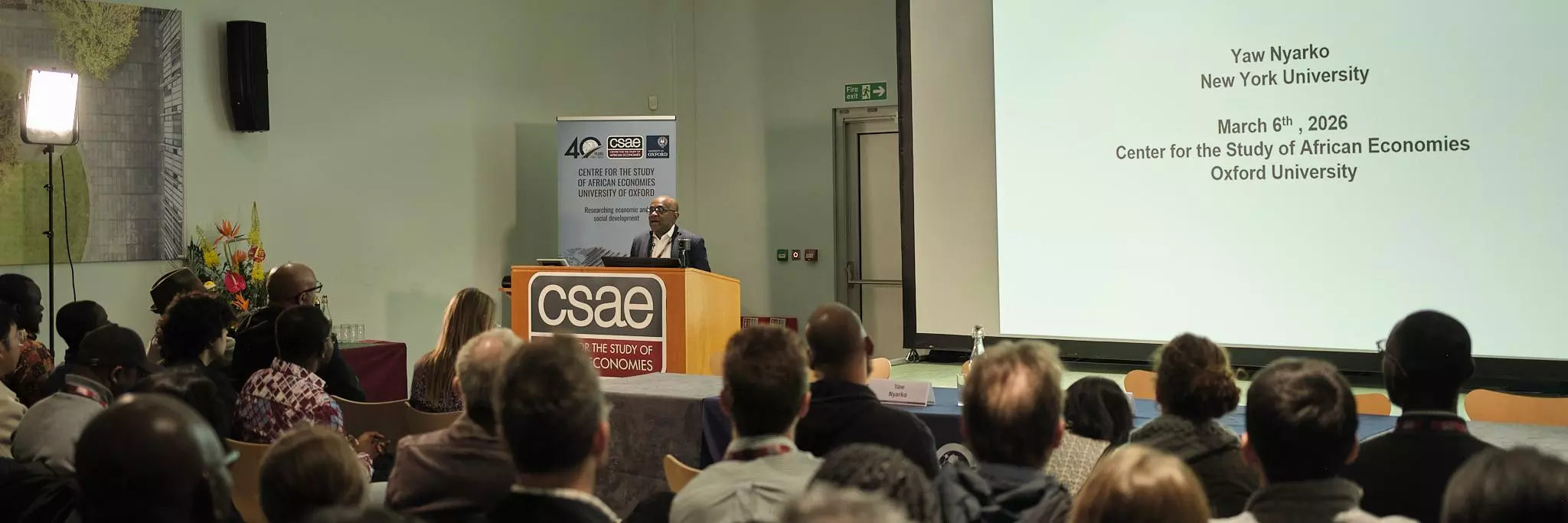
"Do you know what Ghanaians like to do?" Professor Nyarko begins his keynote speech by asking. "We like to complain." Chuckles and nods ripple across the 250 people in the audience. "So I'm going to try not to complain today, and instead, show you solutions." And he does. Titled Transforming Africa: Technology, Agricultural Markets and Climate Change, his speech is an amalgamation of his efforts to fundamentally address the things that are not working in Ghana and most of sub-Saharan Africa, such as land rights, markets, and climate change measures. One of his many achievements is the creation of a land secretariat in a rural farming community in the Ashanti region of Ghana to assist land reforms, settle disputes, and document property rights in a digital database. Another success is the establishment of the Ghana Commodity Exchange which gives farmers the opportunity to integrate into the market and sell their produce, and Professor Nyarko emphasizes that its realization is a fruit of persistence through multiple failures. He ends his speech emphasizing the importance of doing sound academic research without the looming pressure of presenting policy implications. In the engaging discussion with the floor that ensues, the emphasis is on Professor Nyarko's tenet that he stay out of politics (and that it is perfectly possible to do so), and the growing importance of clarifying the theory behind randomized controlled trials (RCTs).
At lunch, development economists, political scientists, and researchers from international organizations and NGOs come together at the same table. The consensus on the food from Ethiopians to Italians: "You know, I braced myself visiting the UK but this is really quite good." What a relief.
The afternoon hosts another two parallel sessions, one of which is the Green Transition and Structural Transformation session. The heterogeneous effects of different types of infrastructure such as transport, water, and telecommunications on different regions in Africa are presented based on evidence from 34 African countries. Another presentation is on the topic of roads and its effect on structural transformation in Mali. In Agriculture, Households, and Communities, the presentations focus on rural agricultural households, although the topics are diverse, from cash transfers and large-scale agricultural investments to financial cooperatives and technology uptake. Questions and comments from the audience are positive and incisive, ranging from suggestions of mechanisms to concerns of endogeneity.
At the end of the day, participants linger for further discussion with presenters or simply to catch up with old friends. Despite the long day, the atmosphere is lively, and hopeful.
Tuesday 24 March - Day Three
Author: Francesca Rosa
The final day of the CSAE Conference 2026 showcased the breadth of contemporary research in African development economics, with sessions spanning agriculture, conflict, governance, taxation, migration, trade, and social protection. Cross-cutting themes such as climate change, energy transition, and inequality ran throughout the programme, highlighting both the diversity of approaches and the interconnected nature of development challenges.
The morning sessions opened with a focus on humanitarian assistance and its wider economic impacts. New evidence on aid reductions in a large refugee camp in Kenya revealed significant declines in food security, consumption, and mental wellbeing, alongside a contraction in local credit markets. Complementary research on a nationwide food assistance programme in Lebanon showed that cuts in support lead households to reduce consumption, accumulate debt, and lose trust in institutions. Together, these findings underscored the far-reaching and often unintended consequences of scaling back humanitarian aid.
A parallel set of sessions explored structural constraints to development and the intersection between economics and geo-politics. Research on spatial inequality in Zambia highlighted the persistent influence of colonial railway infrastructure in shaping present-day economic outcomes, pointing to the long-term importance of historical investments. Other work examined the role of financial inclusion in sub-Saharan Africa, showing how access to banking and mobile money can mitigate the adverse effects of state fragility by strengthening resilience and supporting more inclusive growth. Related research on the Nile Basin emphasised the climate-water-food nexus, demonstrating that uncoordinated water use under climate change can worsen food insecurity, while cooperative basin-wide management could significantly improve outcomes.
In the afternoon, discussions turned to migration and rural transformation. Evidence from Ethiopia suggested that labour mobility can contribute to rural transformation, though outcomes depend on policy context and household characteristics. A field experiment in Senegal found that providing information about legal migration pathways does not substantially alter long-term aspirations, but does reshape behaviour through belief updating. Complementary work using large-scale network data showed that migrant households tend to be more socially connected within their communities, challenging assumptions that migration weakens social cohesion. Discussions coalesced around how to translate insightful work from descriptive analysis into robust causal understanding.
The conference concluded with a thought-provoking panel on "The Science of Scale and Implementation," reflecting on how to translate successful interventions into large-scale impact. Speakers emphasised the importance of working closely with governments, accounting for political and institutional constraints, and advancing research on implementation. The discussion provided a fitting close to a conference that consistently bridged rigorous academic work with real-world policy relevance.
Find out more about what happened at the event via the event page here. You can also watch our round-up short video on the CSAE YouTube channel.